If you’ve ever felt like your crosshair just won’t stay on target, or you keep over‑flicking and missing easy kills, this guide is for you. Mastering Free Fire sensitivity is the single biggest upgrade you can make to your gameplay — it affects everything from looting speed to long‑range spray control. By the end of this tutorial, you’ll have a personalized sensitivity profile that feels natural, improves your accuracy, and helps you win more gunfights.
We’ll start from absolute zero: understanding what each slider does, then moving step‑by‑step through camera sensitivity, ADS sensitivity, gyroscope settings, and fine‑tuning for your specific device. Whether you play on a flagship gaming phone or an older mid‑range device, the same principles apply. You’ll also learn common mistakes that ruin setups and how to avoid them.
What You’ll Need
- Free Fire installed on your phone (any version)
- A stable internet connection (ping under 100ms is ideal)
- At least 10 minutes of uninterrupted training time
- Notepad or a notes app to record your settings
- Basic knowledge of Free Fire’s control layout (shoot, scope, jump, etc.)
Step 1: Reset to Default and Understand the Sliders
Before tweaking anything, go to Settings > Sensitivity and tap “Reset to Default.” This gives you a clean slate. Free Fire divides sensitivity into three main categories: General (camera), Red Dot / 2x / 4x / Sniper (ADS), and Gyroscope (if enabled). Each slider controls how fast your view moves when you drag your finger. Higher values = faster rotation. Lower values = more precise, slow movement. Write down your default numbers so you have a baseline.
Pro tip: Don’t touch the “DPI” or “Resolution” settings in the game’s graphics menu — those don’t affect sensitivity directly. Focus only on the sliders under the Sensitivity tab.
Step 2: Set Your Camera (General) Sensitivity
Camera sensitivity controls how fast your view moves when you’re not aiming down sights. You want it high enough to react quickly but low enough to control. A good starting point is between 70 and 85 for most phones. If you have a high‑end device, you can push it closer to 90. For mid‑range phones, start at 75 and adjust. Test by entering the training ground and doing a 180‑degree flick: your crosshair should land near the target without overshooting. If you overshoot, lower it. If you undershoot, raise it.
Remember, your personal playstyle matters. Aggressive rushers often prefer higher sensitivity, while passive snipers may want lower values. Don’t copy pro players blindly — what works for them may not work for your fingers. For more personalized guidance, check out our guide on custom free fire sensitivity settings.
Step 3: Tune Your ADS Sensitivity (Per Scope)
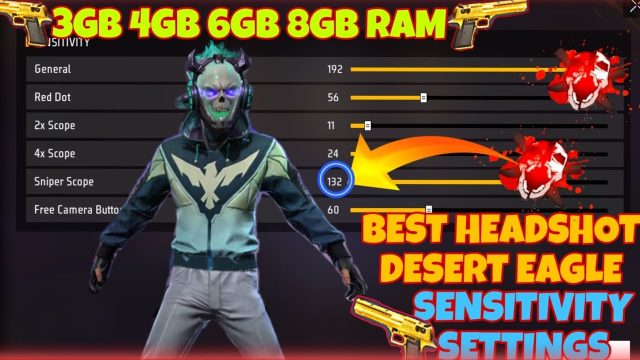
ADS (Aim Down Sights) sensitivity is the most crucial for winning fights. Each scope type needs a different setting. A common mistake is using the same value for all scopes. Here’s a proven starting point: Red Dot: 60–70, 2x Scope: 50–60, 4x Scope: 40–50, Sniper Scope: 30–40. These slower values help you stay on target at range. Fine‑tune by shooting at a stationary target from a distance: if your reticle shakes too much, lower the value; if you can’t track a moving target, raise it slightly.
If you play a lot of close‑quarter battles, you might prefer higher Red Dot sensitivity (70–80). For long‑range sprays, keep the 4x lower. Test each scope in the training ground for at least 2 minutes. Also, note that some devices have a hard time handling high sensitivity without jitter — if that’s you, refer to our free fire sensitivity settings for midrange phones guide for device‑specific tweaks.
Step 4: Enable and Calibrate Gyroscope Sensitivity (Optional but Powerful)
Gyroscope uses your phone’s motion to control the view — tilt the phone to aim. It can make micro‑adjustments much smoother. Go to Settings > Sensitivity and turn on “Gyroscope.” Start with both camera and ADS gyro at 20–30. Then in the training ground, try to follow a moving target by tilting gently. Increase gyro sensitivity gradually until you feel in control. Many top players use gyro for fine aim while using thumb drag for large flicks.
Don’t go above 50 on gyro unless you have very steady hands. High gyro values make the screen jittery with tiny movements. For a deep dive on this subject, read our free fire sensitivity settings for gyroscope users article. If you prefer not to use gyro, skip this step entirely — it’s not mandatory.
Step 5: Test, Record, and Iterate
Now comes the most important part: play at least 5–10 matches with your new settings. Don’t change anything after one game — give your muscle memory time to adapt. Record your gameplay (many phones have a built‑in screen recorder) and watch the clips. Look for moments where you missed because of overshoot or undershoot. Note the situation: close range, mid range, or long range. Then go back to the sensitivity sliders and make small adjustments (increase or decrease by 5 points).
Repeat this cycle for a few days. Your perfect sensitivity is the one that feels like an extension of your hand. Don’t expect instant results; it takes time. If you want a zero‑recoil setup, check out our free fire sensitivity settings no recoil guide for specific values that minimize vertical shake. And if you’re on a high‑end gaming phone, our free fire sensitivity settings for gaming phones page has optimized presets.
Common Pitfalls
- Copying pro players’ sensitivity codes without understanding why they work for them. Pros have unique finger grip, device, and playstyle. Always start from default and adjust to your own feel.
- Changing too many sliders at once. If you modify general, ADS, and gyro all in one go, you won’t know what caused a change. Adjust one slider, test, then move to the next.
- Ignoring device performance. Low‑end phones may drop frames at high sensitivity, making aim feel laggy. If you experience stutter, lower your sensitivity or reduce graphics settings first. Our perfect free fire sensitivity settings guide includes device‑specific advice.
Where to Next
You now have a solid method to dial in your Free Fire sensitivity. The next step is to practice consistently with your new settings. Once you’re comfortable, consider tweaking your HUD layout or button placement for even better control. Happy gaming, and see you in the safe zone!